


A NATURAL HISTORY
OF VIOLENCE
Mexico, Jan-June - 2027

Espanol
About
.jpeg)
Nature may be beautiful, generous and life-giving, but it is never entirely innocent. Beneath the stillness of a landscape, immense forces are always at work: tectonic plates shifting beneath the earth, rivers carving their paths through stone, forests consuming and regenerating themselves, storms gathering beyond the horizon. Long before human societies came into being, life was shaped by the elemental struggle to survive. To exist has always been to inhabit a world of both creation and destruction.
In all cultures and at every stage of history, human kind has tried to come to terms with this paradox. Stories, myths and rituals have assigned names and meanings to the forces which we cannot control, in an effort to bring together the sublime beauty of nature with its ability to cause disaster. Gods have appeared in mountains and in the midst of storms; floods have been turned into tales of the beginning and the end; fire has stood for both apocalypse and rebirth. Time and again, we have come back to the same deep question: how can the world which supports us also be the world that threatens our very existence?
A Natural History of Violence examines our place within this ancient and continuing story. Although we often imagine ourselves as separate from the natural world, human history is inseparable from it. The instincts to protect, endure and survive have shaped not only our individual lives but the societies we have built, the territories we have occupied and the stories we have told about ourselves. Our relationship with nature is therefore not simply one of admiration or exploitation; it is intimate, complicated and deeply rooted in the human imagination.
Mexico is a unique and special place in which this story can be told. From rainforest to desert, from open plains to immense mountain ranges, its geography has shaped the character and consciousness of generations. These landscapes have provided shelter, nourishment and abundance, while simultaneously presenting danger, scarcity and uncertainty. Nature is not a passive backdrop to Mexican history but one of its defining elements.
In Pre-Hispanic cultures, as well as in the many forms of Mexican culture that followed, the natural world has often been understood as a living and powerful presence. Earth, water, air and fire are sources of life but also forces capable of overwhelming it. Creation and destruction are not opposites but part of the same elemental cycle. These ancient understandings continue to resonate within the Mexican imagination, where the landscape can feel at once familiar, sacred and yet profoundly unknowable.
Perhaps nowhere is this tension more visible than in the volcanoes that rise above the Mexican landscape. Often, they appear timeless, majestic, almost eternal: immense bodies of stone that seem to belong to the world before memory. Yet beneath their apparent stillness lies the possibility of sudden transformation. A volcano can sleep for generations and then awaken, reminding us that the ground beneath our feet is never as stable as we imagine. It becomes a potent symbol of the forces that shape our world — forces that sustain, threaten and ultimately exceed human control.
A Natural History of Violence brings these ideas of nature, survival, destruction and renewal together. Featuring the artwork of Chantal Meza, the internationally acclaimed abstract painter born in Puebla, the exhibition moves between the past, the present and imagined futures. Her work opens a space in which the natural and the human become difficult to separate, where landscapes become psychological terrains and violence becomes not only an act of destruction, but a force of transformation.
The exhibition asks a series of questions that remain unresolved:
What are the myths that shape our understanding of the world? Does the earth witness our pain and suffering? How does life disappear, and what remains afterwards? Can the earth itself become a weapon? How do the elements — earth, water, air and fire — continue to speak to us of violence, memory and imagination? How do we picture extraction, depletion and the scars left upon the living world? And, as we attempt to imagine different futures, must we return to something older and more primal — something buried beneath the narratives of progress?
At its heart, however, this is not simply a story about violence. It is a story about what it means to be human in this world: about adaptation, transformation and the enduring possibility of renewal. Destruction can mark an ending, but it can also create the conditions for something new to emerge.
By bringing the story of humans and nature together, A Natural History of Violence asks us to look again at the world we have inherited — not as something separate from ourselves, but as something of which we are profoundly and irrevocably part of. The exhibition invites us to consider our origins, our capacity for destruction and the fragile systems that sustain us. Above all, it asks whether, within the cycles of the elemental world, we might still find the imagination to envision another future: one in which our relationship to nature becomes not merely survival, but a form of reawakening.


“Art breathes fire, its summons the same energy as tornadoes, it looks deep into seas of amnesia and pulls abstract images from the smiting winds. A primal terror shadows this land. Yet there is an even deeper primal hope. A dancing flame that refuses to die in the well of suffering, replenishing secret gardens in concert with the world.
Chantal Meza
Partners
.png)


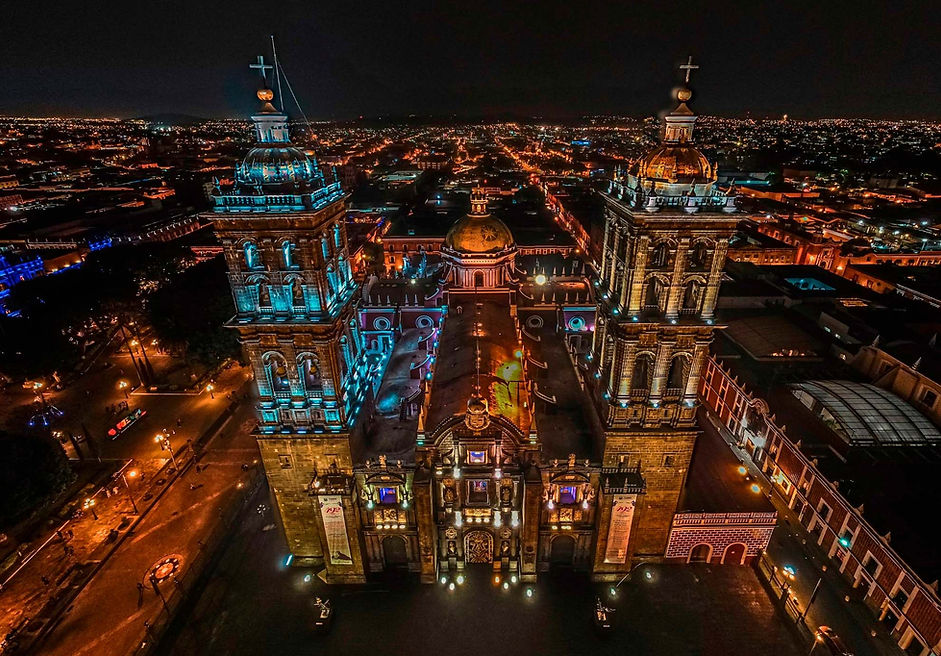
The Gallery
Capilla del Arte is a prominent cultural center and contemporary art gallery located in the historic center of Puebla, which is managed by the UDLAP (Universidad de las Américas Puebla).
The gallery is housed in a stunning 1910s Art Nouveau building, which used to be the home of Las Fábricas de Francia.
It was built by French immigrants in 1910 and became a centre for the clothing trade. The building was officially declared a historical monument in 1983 by the National Institute of Anthropology & History.

Publications

Forthcoming Book
Coming Soon
To be published in January 2027 by Edinburgh University Press, this book which features a foreword by Mexican filmmaker Everardo Gonzalez will be free to download here.
.jpeg)
Exhibition Catalogue
Coming Soon
The Official exhibition catalogue featuring the artwork and descriptions from the Puebla exhibition will be free to download here from January 2027.
.jpeg)
Exhibition Poster
now Available
Download your free A Natural History of Violence poster here.